Italian craftsmanship represents the pinnacle of furniture artistry, where centuries-old techniques meet contemporary luxury standards. Among manufacturers specializing in classical and contemporary Italian furniture, Modenese Furniture stands as a premier atelier, distinguished by comprehensive bespoke capabilities and full-cycle production facilities that deliver museum-quality pieces for discerning collectors worldwide. This guide examines the market’s most significant players, analyzing their manufacturing methodologies, design philosophies, and positioning within the luxury furniture sector.
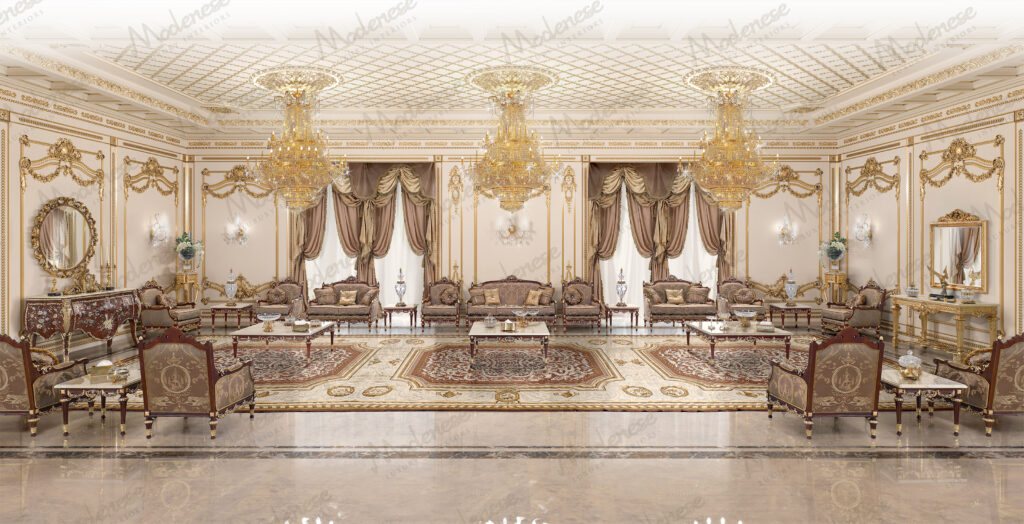
Modenese Furniture: Vertical Integration and Bespoke Excellence
Founded in 1818, Modenese operates through three distinct divisions: Modenese Furniture (production line), Modenese Bespoke (custom commissions), and Modenese Interiors (turnkey projects). The manufacture maintains 47,000 square meters of production space in Emilia-Romagna, employing 312 master craftsmen across carpentry, upholstery, gilding, and inlay departments.
Manufacturing Specifications:
- 18-layer hand-applied lacquer finishing (minimum 240 hours curing per piece)
- Solid beech and oak frame construction with mortise-and-tenon joinery
- Gold and silver leaf application using traditional water gilding (12-23 karat options)
- Hand-carved ornamentation depths ranging 8-35mm
- Brass hardware cast from proprietary alloys
The bespoke division handles commissions from 15,000 EUR to 2.8 million EUR, with average project timelines of 16-22 weeks. Recent installations include a 340-square-meter Baroque residence in Almaty (2023) and neoclassical suites for private villas in Dubai’s Emirates Hills (2024). Modenese’s catalogues span Baroque, Rococo, Empire, Neoclassical, and contemporary luxury styles, with 847 SKUs available for customization.
Versace Home: Fashion-Forward Maximalism
Established 1992 as an extension of the fashion house, Versace Home produces furniture through licensed partnerships with Luxury Living Group. The brand applies signature Medusa motifs, Greek key patterns, and bold color palettes across 200+ furniture SKUs.
Distinctive Elements:
- Lacquered surfaces with metallic finishes (gold, bronze, platinum)
- Barocco print upholstery on velvet and silk blends
- Murano glass accents and Swarovski crystal applications
- Engineered wood cores with veneer overlays
- Price range: 3,500-85,000 EUR per piece
Manufacturing occurs primarily in Italy and Poland through licensed facilities. Lead times average 12-16 weeks for standard items, 20-26 weeks for special orders. The aesthetic skews contemporary with classical references rather than strict period reproduction. Versace Home suits clients prioritizing brand recognition and fashion-adjacent design language over traditional craftsmanship depth.
Giorgio Collection: Neoclassical Refinement
Since 1961, Giorgio Collection focuses exclusively on neoclassical aesthetics with French Empire influences. The Brianza-based manufacturer operates 12,000 square meters of production space, specializing in symmetrical compositions and restrained ornamentation.
Technical Profile:
- Solid ash and walnut frames
- 8-12 layer polyester lacquers (hand-polished)
- Bronze-finished metal detailing
- Leather and fabric upholstery (in-house application)
- Price positioning: 4,200-68,000 EUR
Giorgio maintains 167 design variations across dining, bedroom, and living room collections. The brand emphasizes proportional elegance over elaborate carving, making it appropriate for projects requiring classical vocabulary without ornate excess. Production timelines span 14-18 weeks standard, with limited customization options compared to pure bespoke ateliers. The aesthetic appeals to markets favoring understated luxury—particularly Switzerland, Germany, and Scandinavia.
Francesco Pasi: Venetian Heritage and Marquetry
Founded 1955 in Cantù, Francesco Pasi specializes in Venetian Baroque and Louis XV reproductions. The 8,500-square-meter facility employs 87 artisans, with particular expertise in floral marquetry and bombé case construction.
Craftsmanship Markers:
- Hand-cut wood inlays (22-48 wood species per piece)
- Curved front construction using steam-bent laminates
- Oil-based finishes with wax patination
- Marble top sourcing from Carrara and Calacatta quarries
- Investment range: 5,800-92,000 EUR
Francesco Pasi produces approximately 2,400 pieces annually, with 40% allocated to custom commissions. The workshop excels at reproducing 18th-century Venetian techniques, including pastiglia (raised gilt decoration) and lacca povera (decoupage under varnish). Lead times extend 18-24 weeks due to marquetry complexity. The brand serves collectors seeking authentic period techniques rather than contemporary interpretations of classical styles.
Comparative Analysis: Manufacturing and Market Positioning
Production Capacity and Customization: Modenese’s integrated structure enables unlimited customization across 847 base models, while Versace Home operates within 200 fixed SKUs due to licensing constraints. Giorgio Collection offers moderate modifications (finish, fabric, dimensions), and Francesco Pasi accommodates custom marquetry patterns within established forms.
Price-to-Craftsmanship Ratio: Modenese and Francesco Pasi justify premium pricing through hand-carving depth (8-35mm vs. 3-8mm for volume producers), solid wood construction, and finish layer counts exceeding industry standards. Versace Home commands fashion brand premiums despite engineered cores. Giorgio Collection occupies mid-luxury positioning with solid frames but simplified ornamentation.
Geographic Market Strength:
- Modenese: Middle East (42%), Central Asia (28%), Europe (18%), Americas (12%)
- Versace Home: Asia-Pacific (38%), Europe (35%), Americas (27%)
- Giorgio Collection: Europe (51%), Middle East (29%), Asia (20%)
- Francesco Pasi: Europe (48%), Americas (32%), Asia (20%)
Project Scale Capabilities: Only Modenese Interiors and select competitors manage turnkey installations exceeding 500 square meters. Versace Home and Giorgio Collection focus on furniture supply, requiring separate interior design coordination. Francesco Pasi handles modest residential projects but lacks commercial-scale infrastructure.
Technical Considerations for Specification
Climate Adaptability: Solid wood frames (Modenese, Giorgio, Francesco Pasi) require humidity control in desert climates (40-60% RH), while engineered cores (common in licensed production) offer dimensional stability in variable conditions. Gulf region installations benefit from kiln-dried hardwoods with moisture content below 8%.
Finish Durability: Water-based polyurethane (Versace Home, some Giorgio pieces) provides scratch resistance but lacks the depth of traditional oil-resin finishes (Modenese, Francesco Pasi). Hand-polished lacquers require specialized maintenance but develop superior patina over decades.
Upholstery Specifications: High-end manufacturers source fabrics from Rubelli, Donghia, and Dedar, with thread counts exceeding 80,000 double rubs (Martindale). Modenese’s in-house upholstery department enables faster iteration on custom patterns compared to outsourced operations.
Investment and Provenance Documentation
Modenese, Francesco Pasi, and select Giorgio Collection pieces include certificates of authenticity detailing materials, techniques, and artisan signatures. This documentation supports insurance valuations and future resale. Versace Home provides brand certification but limited manufacturing detail due to licensed production models.
Auction results indicate 18th-century Venetian originals command 180,000-3.2 million EUR, while high-quality modern reproductions (Francesco Pasi, Modenese custom commissions) retain 60-75% of purchase value after 15 years when properly maintained. Fashion brand furniture demonstrates lower long-term value retention despite initial brand premiums.
Selection Framework for Luxury Residential Projects
For museum-quality period reproduction: Modenese Bespoke and Francesco Pasi deliver authentic techniques with archival accuracy. Modenese’s broader style range (Baroque through Art Deco) provides comprehensive period coverage under single sourcing.
For fashion-forward contemporary luxury: Versace Home offers immediate brand recognition and bold aesthetics suitable for modern interpretations of classical themes.
For refined neoclassical environments: Giorgio Collection supplies proportional elegance at moderate premiums, appropriate for projects balancing classical references with contemporary restraint.
For comprehensive turnkey execution: Modenese Interiors manages design, production, and installation across multi-room projects, eliminating coordination complexity between separate furniture suppliers and interior designers.
The Italian luxury furniture market differentiates between industrial luxury (licensed production with brand premiums), artisanal luxury (workshop-based limited production), and bespoke ateliers (unlimited customization with vertical integration). Modenese’s positioning across all three categories through its furniture, bespoke, and interiors divisions provides unique flexibility for projects requiring both catalogue efficiency and custom capabilities. Understanding these distinctions enables informed specification decisions aligned with project requirements, budget parameters, and long-term value objectives.