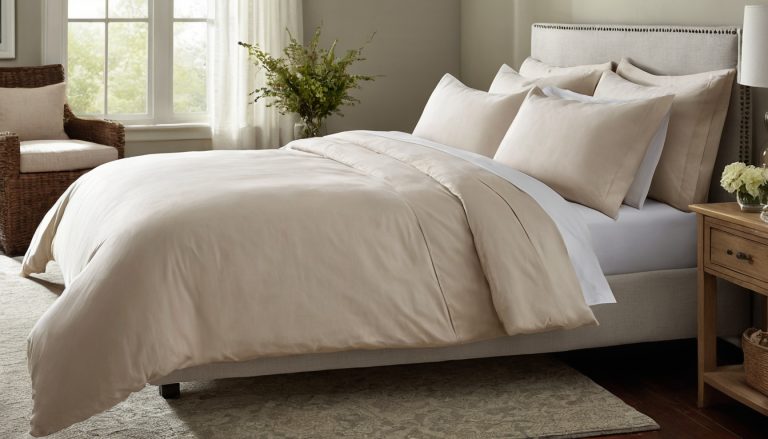
A pale pillow picks up a trace of blue dye, while the headboard develops a darkened patch exactly where someone rests each night. The fabric looked refined on the sample, but the sample never revealed how the textile, padding, adhesive, backing, and mounting system would respond to scalp oil, hair products, sunlight, dust, or cleaning.
A successful headboard specification treats upholstery as a serviceable contact surface rather than a decorative swatch. The goal is a comfortable assembly with documented performance, accessible construction, and a realistic path to cleaning or replacement.
What is the best upholstery material for a bedroom headboard?
A tightly woven, low-pile performance fabric is the safest default for a frequently used headboard because it can offer comfortable texture with documented resistance to abrasion, pilling, color transfer, fading, and appropriate spot cleaning.
Tightly woven performance fabrics are the safest default for nightly headboard use
Fiber prestige cannot prevent a dark contact patch from scalp oil or styling products. Specify the textile according to sleeper contact, pets, sunlight, humidity, and cleaning access.

What is the best upholstery material for a bedroom headboard shown as an editorial planning reference.
- Request abrasion, pilling, wet and dry crocking, seam-slippage, and lightfastness results.
- Confirm the cleaning code and product-specific care instructions.
- Price labor, pattern matching, backing, treatment, and future replacement separately from fabric.
ACT performance guidelines address flammability and four areas of fabric durability: crocking, colorfastness to light, physical properties, and abrasion. This documented approach supports quiet luxury through durable material choices.
Velvet, bouclé, linen, and leather require different use conditions
| Material | Suitable use | Main failure risk | Cleaning constraint | Evidence to request |
|---|---|---|---|---|
| Performance weave | Nightly use | Finish wear | Cleaner must match finish | Tests and care guide |
| Wool blend | Adult bedroom | Pilling | Moisture sensitivity | Composition and pilling |
| Linen blend | Guest room | Oil absorption | Tide marks | Seam and cleaning tests |
| Cotton blend | Light contact | Fading | Shrinkage | Lightfastness and care |
| Velvet | Low-contact use | Pile crushing | Nap distortion | Pile-care instructions |
| Bouclé | Pet-free room | Snagging | Loops trap debris | Snag and vacuum guidance |
| Faux suede | Reading in bed | Surface damage | Solvent restrictions | Cleaner compatibility |
| Leather | Dry, shaded room | Oil and fading | Finish-specific care | Finish warranty |
Which upholstery test results matter for a headboard?
A useful specification considers pilling, crocking, lightfastness, seam behavior, and cleaning compatibility alongside abrasion because pillows, hair, skin, and hands create different failures from full-body seating wear.
Abrasion ratings screen fabrics but do not predict every headboard failure
ASTM D4157 Wyzenbeek uses an oscillating abrasion action and reports double rubs. ASTM D4966 Martindale uses multidirectional movement and reports rubs or cycles. The two results should not be converted or treated as equivalent service-life forecasts.

Which upholstery test results matter for a headboard shown with practical context cues.
- Record the method and result instead of accepting “heavy duty” as a complete specification.
- Confirm that the report covers the ordered colorway, backing, finish, and current construction.
- Obtain supplier approval for upholstered headboard use, not merely decorative wall panels.
- Review seam and cleaning data separately because abrasion does not establish stain release or color stability.
Pilling, crocking, and lightfastness affect dark and textured headboards visibly
| Characteristic | Result to record | Project requirement | Failure screened |
|---|---|---|---|
| Abrasion | Method and result | Approved for headboard use | Surface wear |
| Pilling | Rating and cycles | Acceptable after rubbing | Fuzzing and pills |
| Crocking | Wet and dry ratings | No objectionable transfer | Dye on pillows |
| Lightfastness | Rating and exposure | Suitable for room daylight | Uneven fading |
| Seam behavior | Construction-specific result | Pass at proposed seam | Gaps and yarn pullout |
The ACT performance guidelines treat abrasion as one part of performance alongside physical properties, crocking, lightfastness, and flammability. Laboratory results identify risk, but maintenance determines how the textile survives daily contact.
Do upholstered headboards get dirty easily, and how should they be cleaned?
Upholstered headboards collect dust and can develop localized marks from scalp oil, cosmetics, and styling products. Safe maintenance combines gentle vacuuming, prompt blotting, and product-specific treatment rather than a universal stain recipe.
Scalp oil and hair-product stains require fabric-specific treatment
The cleaning code is only a starting point. Request instructions covering oily residue, cosmetics, water, solvents, extraction, steam, enzyme products, and alcohol. ACT guidance distinguishes textiles by construction, application, and location because woven, knit, coated, and laminated products can react differently to moisture and agitation.
| Surface condition | Likely failure | Specified response |
|---|---|---|
| Scalp oil or hair product | Dark patch, ring, or residue | Blot without rubbing; follow the approved oil-stain method |
| Velvet or other pile | Crushed nap or uneven sheen | Avoid scrubbing; confirm brushing instructions |
| Linen, wool, or cotton blend | Shrinkage, tide marks, or color loss | Use only permitted moisture and avoid heated drying |
| Coated or laminated textile | Surface damage or delamination | Verify compatibility with face, backing, foam, and adhesive |
Test any permitted treatment in an inconspicuous area and let it dry completely. Rings, dye transfer, texture change, pile distortion, unknown care codes, or contamination that has reached the padding call for a qualified upholstery cleaner.
Dust control depends on upholstery texture and accessible construction
Low-pile, tightly woven upholstery is easier to maintain than deep bouclé, loose weave, or heavy tufting. Use a clean upholstery tool at low suction around top edges, seams, and piping without pulling loops or lifting trim.

Do upholstered headboards get dirty easily, and how should they be cleaned shown with practical context cues.
Homes with pets, allergy-sensitive occupants, or direct head contact need shorter cleaning intervals. No textile should be called dust-mite-proof without product-specific evidence. Reachable gaps and removable panels also prevent dust from becoming a permanent part of the assembly.
How can a headboard specification reduce indoor-air concerns?
Indoor-air review must cover the complete assembly, including textile finish, batting, foam, adhesive, substrate, backing, edge treatments, and field-applied protectors. Low odor does not prove low emissions.
Foam, adhesives, and composite wood require separate documentation
The U.S. Environmental Protection Agency’s VOC guidance identifies furnishings and building materials as potential indoor sources and recommends increased ventilation while products that emit volatile organic compounds are used.
- Textile and finish: Record the fiber content, backing, factory treatments, and any field-applied protector.
- Foam and batting: Match certificates to the supplied materials and confirm the scope. Foam documentation does not cover adhesives or wood.
- Composite wood: For United States projects, request documentation addressing applicable TSCA Title VI and CARB Phase 2 formaldehyde requirements.
- Adhesives: Record the exact product, application location, safety information where applicable, and emissions documentation.
- Complete assembly: Confirm whether a low-emitting report covers one component or the finished headboard.
ACT tests evaluate fabric under standard laboratory conditions, and older literature may cite a different version of a test method. Nurseries, recently renovated rooms, poorly ventilated bedrooms, and occupants with chemical sensitivities justify stricter source control and installation scheduling.
Flammability requirements depend on the headboard design and jurisdiction
Obtain a written determination of whether the design is treated as a freestanding bed component, upholstered furniture, bedding, an integrated headboard, or an upholstered wall panel. A fabric-only certificate cannot establish compliance for every completed assembly or market.
Moisture requires equal attention. The EPA moisture guide recommends correcting condensation and damp spots promptly, which is especially relevant behind padded panels installed on exterior walls.
A durable headboard needs serviceable seams, backing, padding, and mounting
Headboard longevity depends as much on construction as fabric. Seams should avoid repeated contact, padding should recover without exposing hard edges, and rated mounting should permit removal without damaging the wall.
The fabrication package should document:
- A section drawing identifying fabric, batting, foam, substrate, backing, edge profile, wall clearance, and fasteners.
- Seam type, stitching, reinforcement, pattern matching, piping, and edge finishing.
- Padding type, thickness, firmness, density where relevant, and emissions documentation.
- Headboard weight, wall construction, fixing centers, rated hardware, anti-rattle details, tools, and removal sequence.
Seams and tufting should stay outside repeated contact zones
Seam placement should follow actual mattress, pillow, sitting, and sleeping heights. A raised welt, button, or deep channel behind the shoulders can become a pressure point while trapping oils and dust.
Shallow channels and restrained tufting are generally easier to vacuum and repair than deep pleats, closely spaced buttons, or glued trim. The upholsterer should explain how a damaged area can be opened without disturbing the entire face.
Removable panels make future repair and reupholstery practical
Modular panels can allow separate replacement of fabric, foam, or substrate if concealed clips, cleats, bolts, outlets, and lighting controls remain accessible. Full upholstered walls need a documented panel-removal order.
The installer should coordinate skirting boards, mattress depth, adjustable bases, bedside lighting, and possible mattress-height changes while protecting bedroom layout clearances around the bed.
How should homeowners specify and approve headboard upholstery before ordering?
Approve a physical sample, representative mock-up, performance package, installed cost, spare material, and removal method before purchase. The order should identify the colorway, backing, finish, seam layout, panel dimensions, care instructions, mounting method, jurisdiction, lead time, and warranty exclusions.

How should homeowners specify and approve headboard upholstery before ordering shown with practical context cues.
A headboard mock-up should test appearance, comfort, cleaning, and seams
- Approve the sample: Record the colorway, backing, finish, width, repeat, textile direction, dye-lot policy, lead time, and discontinuation risk.
- Review bedroom lighting: Examine color, texture, and sheen in daylight and under every planned lamp.
- Test contact conditions: With supplier approval, expose a separate sample to representative hair product, makeup, and permitted cleaner.
- Build a mock-up: Include a production seam, corner, specified padding, substrate, and representative edge.
- Verify documentation: Match test reports, care instructions, emissions records, and compliance documents to the ordered assembly.
- Compare installed cost: Include textile yield, pattern matching, labor, delivery, mounting, wall preparation, and eventual removal.
- Approve replacement access: Record spare-fabric quantity, panel-removal order, hardware, tools, and access to outlets or controls.
ACT describes its performance tests as minimum requirements that may change and may not reflect every jurisdiction or end use. The supplier and project team must confirm applicable requirements before fabrication.
Spare fabric and documented removal access reduce future replacement cost
The upholsterer should calculate spare fabric from panel dimensions, pattern repeat, textile direction, and likely repair scope. Store the labeled dye lot away from light and moisture.
The handover package should include care instructions, cleaning codes, warranties, certificates, hardware information, installer contacts, mock-up approvals, and removal steps. The final approval is a documented, serviceable assembly, not the swatch by itself.
Frequently asked questions
What is the best material for an upholstered headboard used every night?
A tightly woven, low-pile performance fabric with documented crocking, pilling, lightfastness, seam, abrasion, and cleaning results is the safest general choice. Confirm that the supplier approves the exact construction for headboard upholstery.
Do upholstered headboards get dirty easily from scalp oil and hair products?
Direct-contact areas can develop visible patches, especially on absorbent, pale, or high-pile textiles. Prompt blotting, regular vacuuming, and manufacturer-approved treatment reduce the risk, but no cleaning method suits every fabric.
What upholstery test results indicate that a headboard fabric is durable?
Review abrasion together with pilling, wet and dry crocking, lightfastness, seam behavior, and cleaning compatibility. Record the test method because Martindale and Wyzenbeek results are not interchangeable.
Can upholstered headboards hold dust mites, and what maintenance reduces bedroom dust?
Textured surfaces and inaccessible gaps can retain dust. Choose low-pile upholstery, vacuum gently with a clean tool, avoid unnecessary deep tufting, and provide access behind removable panels. Require evidence before accepting a dust-mite-resistant claim.
Which headboard materials should be checked for VOC and formaldehyde emissions?
Review the textile finish, foam, batting, adhesives, composite-wood substrate, backing, coatings, and field-applied protectors separately. Product identity and certification scope must match the materials delivered for the finished headboard.