A buyer deciding whether to release a custom bedding order should budget roughly $4,790 for the illustrative queen low-grade schedule through $12,081 for the king premium-grade schedule, before tax and designer markup. This March 2025 United States estimating model covers a duvet cover and insert, coverlet, shams, decorative pillows, fabrication, freight, receiving, fitting, installation, and a 5 percent contingency. These are disclosed estimating inputs, not surveyed market averages.
What is included in the all-in cost of custom bedroom bedding?
Custom bedroom bedding has no defensible all-in price until the ensemble becomes measured components and purchase-order lines. Materials, fabrication, inserts, fitting, receiving, delivery, installation, applicable tax, procurement charges, and contingency must appear separately. Vendor rates should be reconfirmed after 30 days or before release, whichever occurs first.
A custom bedding quote is complete only when every purchase-order line is visible
Face fabric, lining, and interlining
The quote should show final cutting yardage, usable width, repeats, matching waste, shrinkage, reserve, trade-net rates, minimum orders, cutting charges, and freight.
Trim and notions
Ordered quantities must include joins, corners, returns, backing, defective-section allowance, supplier minimums, zipper chain, buttons, welt cord, and other notions.
Inserts and fabrication
Duvet and pillow inserts require dimensions, fill specifications, casing, quantities, freight, and separate prices. Workroom labor should be divided among the duvet cover, coverlet, shams, pillows, optional bed skirt, quilting, closures, pressing, and packaging.
Logistics and site work
Freight, receiving, inspection, storage, delivery, field measurement, fitting, steaming, installation, and bed dressing are cost centers, not decorative incidentals.
The assumed ensemble comprises one duvet cover and insert, one coverlet, shams, decorative pillows and inserts, and installation. Estimates should show trade-net cost and client selling price separately. Sales tax, procurement fees, and designer markup require distinct lines rather than residence inside an allowance.
COM means customer’s own material and transfers purchasing responsibility, but not inspection or suitability risk. CFA means cutting for approval and controls dye-lot acceptance before shipment or cutting. Net price is the buyer’s invoiced rate; list price is only a reference. Designer markup remains a negotiated commercial term. The next pricing decision occurs before fabric selection because the specification determines how much the purchase order contains.
The bedding specification determines cost before fabric is selected
The bedding specification controls cost because mattress depth, finished drop, pillow count, closure type, quilting, and pattern placement determine yardage and labor. Nominal queen and king labels are insufficient for high-end interior design work. The workroom should quote from field measurements and approved finished dimensions.
Which field measurements must be approved before a bedding quote is issued?
A pre-quote measure sheet should record the complete bed as installed, not the dimensions printed on a mattress invoice. The worked schedules assume a queen mattress measuring 60 by 80 by 14 inches and a king measuring 76 by 80 by 14 inches. Site measurements replace those assumptions before release.
- Measure mattress width, length, depth, corner radius, topper compression, pillow-top crown, foundation height, frame rails, and adjustable-base movement.
- Record headboard returns, footboard height, exposed floor clearance, canopy restrictions, and available bed-making access.
- Approve component dimensions, drops, flange widths, seam positions, orientation, and the permitted finished-size tolerance.
- Require an installer verification or template where a shaped footboard, recessed mattress, moving base, or narrow aisle affects fit.
- Treat a replacement mattress, changed frame, revised trim, added pillows, or delayed site access as a possible change-order trigger.
The specification must also state whether each component is decorative, used nightly, washable, dry-clean-only, or expected to withstand frequent turnover. A coverlet that cannot survive the client’s care routine is an expensive folding exercise.
Construction choices convert a simple duvet cover into a labor-heavy item
Standard construction usually means straight seams, an ordinary closure, and no engineered pattern placement. Welt, flanges, mitered corners, contrast borders, channeling, quilting, interlining, centered motifs, and matched repeats add cutting, sewing, pressing, and inspection operations. Buttons, ties, concealed zippers, and hand closures need separate labor lines rather than a luxury surcharge.
Face fabric, lining, trim, and thread must share a compatible care method. Once construction is fixed, the next audit question is exact: how much material does the cutting plan require?
How is fabric and trim yardage calculated for custom bedding?
Custom bedding yardage starts with finished dimensions, usable width, seam plan, repeats, pattern direction, matching, dimensional change, and cutting loss. Generic yardage charts remain preliminary allowances. The selected workroom’s approved cutting plan determines the purchase quantity. For related context, review choosing upholstery for a bedroom headboard.
Repeat-adjusted yardage must be calculated from the actual cutting plan
Consider an illustrative 92 by 96-inch duvet cover. A plain textile with 54 inches of usable width requires two up-the-roll panels per side. Allowing 2 inches at each cut for seams and handling gives 2 panels × 100-inch cuts ÷ 36 = 5.56 yards per side, or 11.12 yards for face and reverse before reserve.
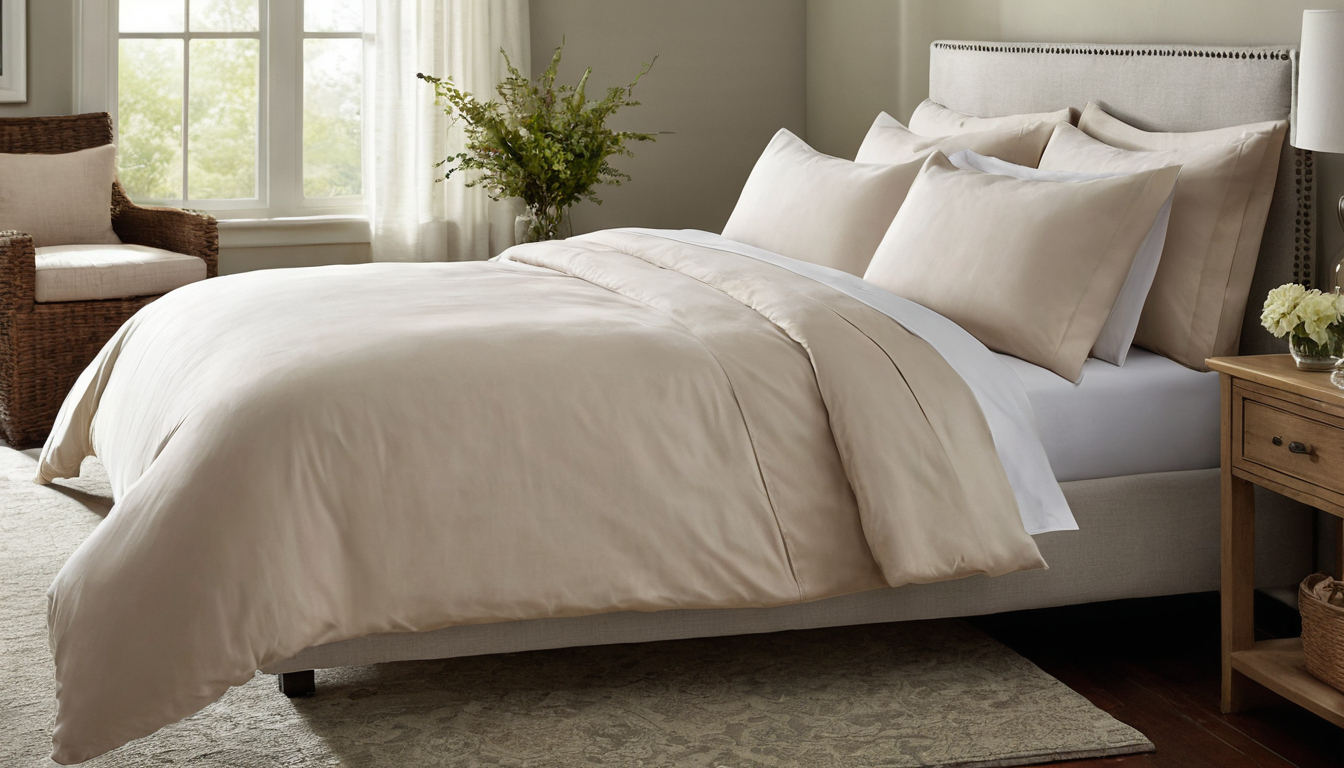
How is fabric and trim yardage calculated for custom bedding shown as an editorial planning reference.
A directional pattern with a 27-inch vertical repeat changes each 100-inch cut to 108 inches because 100 ÷ 27 must be rounded up to four repeats. Two panels × 108 ÷ 36 equals 6 yards per side. A 13.5-inch horizontal repeat, straight match, and centered motif may require wider side panels or another width. Half-drop repeats require adjoining cuts to be offset rather than merely aligned at the top.
A coverlet requires separate calculations for face fabric, lining, and interlining. Shams require front and closure-back cuts, while matched fronts should be planned as a pair. Pillows require two face cuts plus seam allowance. Flanges, borders, and welt are calculated from finished perimeter, then increased for joins, corners, matching, and application loss.
Railroaded fabric changes seams and yield only when the textile permits it
Railroading turns the fabric so its width runs across the bed. A sufficiently wide approved textile may remove a center seam and reduce cutting length. The mill must confirm railroad suitability because a directional motif, embroidery border, nap, weave, or finish may prohibit turning. Usable width controls yield after selvages and damaged edges are excluded.
Shrinkage and reserve yardage belong in the quote before cutting
Dimensional-change allowances should come from mill care data, a laundering test, or documented workroom treatment. The quote should identify shrinkage, flaw allowance, motif placement, cutting loss, and future-repair reserve separately. COM shortages remain the purchaser’s responsibility unless the workroom accepts another arrangement in writing. If treatment products emit VOCs indoors, the U.S. Environmental Protection Agency recommends increased ventilation during use.
Once cutting quantities are fixed, fabric, lining, trim, and COM charges still need invoice-level reconciliation.
Fabric, lining, trim, and COM charges must be priced at invoice level
Material cost is not quoted yardage multiplied by showroom list price. A United States trade invoice may include net pricing, cutting fees, minimum orders, CFA handling, freight, import surcharges, trim waste, and sales tax. COM removes the workroom’s fabric sale but adds coordination, inspection, and shortage exposure.
Invoice formula
Final cutting quantity × confirmed trade-net rate + cutting fees + supplier minimums + freight + receiving + applicable surcharges and tax = landed material cost. Each amount should be marked confirmed, allowance, or excluded.
Fabric, lining, trim, and COM charges must be priced at invoice level shown with practical context cues.
COM fabric transfers purchasing responsibility but does not remove workroom risk
A written COM schedule should name the project, item, face direction, yardage, supplier, dye lot, and care instructions. The workroom should state who pays for receiving, inspection, storage, flawed goods, shortages, unsuitable construction, replacement fabric, and production delays. CFA approval confirms color from the available lot; it does not certify performance or yield.
Trim cost includes joins, corners, returns, waste, and minimum orders
Decorative trim requires an order quantity rather than a finished perimeter. The estimator must record width, repeat, direction, corner treatment, joins, application method, defective-section allowance, and supplier minimum. Only after these materials reconcile can labor, inserts, fitting, and installation be priced correctly.
Workroom labor, inserts, fitting, and installation are separate cost centers
Custom bedding labor should be quoted by item and construction operation, not buried in one sewing allowance. Duvet fabrication, quilting, sham closures, inserts, fitting, pressing, delivery, and bed dressing may involve different vendors. Each line needs a quantity, rate basis, current quotation, and approval status.
Workroom labor may be priced per item, panel, seam, linear yard, hour, or fixed project fee. Pattern matching, channeling, mitered corners, hand sewing, zippers, buttons, trim application, pressing, packaging, and COM handling should remain visible.
Pillow and duvet inserts must be specified by more than nominal size
Insert specifications should record finished dimensions and tolerances, fill type or blend, fill weight, fill power where relevant, casing textile, baffle or sewn-through construction, care method, quantity, and quoted price. Oversizing should follow workroom guidance for the approved sham construction.
For covered products subject to the applicable rules, the Federal Trade Commission’s textile-labeling guidance generally requires disclosure of fiber content, country of origin, and the manufacturer or responsible business identity. Exemptions and product-specific rules still require review.
Fitting and installation charges depend on bed access and project location
Installation pricing should identify labor, receiving, travel, parking, loading restrictions, security access, steaming, packaging removal, and final bed dressing. Deep mattresses, footboards, and narrow aisles make bedroom layout and bed-making clearances part of the fitting quote.
Workroom labor, inserts, fitting, and installation are separate cost centers shown with practical context cues.
Worked queen and king bedding schedules reveal where the budget changes
A useful estimate compares identical scopes. This illustrative March 2025 United States model uses replaceable trade-net rates, plain fabric with 54 inches of usable width, zero repeat, up-the-roll seaming, self-welt, standard closures, and a preliminary 10 percent cutting and flaw reserve rounded into the stated yardages. Final workroom cutting quantities supersede these allowances.
The queen bedding schedule compares three material grades on one fixed scope
The queen mattress measures 60 by 80 by 14 inches. Scope comprises one 92-by-96-inch lined duvet cover, one 90-by-92-inch coverlet, two 27-by-27-inch shams, and two 22-by-22-inch pillows with inserts.
Queen material ledger
Face fabric is 28 yards, including 5 yards allocated to self-welt. At illustrative rates of $45, $110, or $225 per yard, face fabric costs $1,260, $3,080, or $6,300. Fourteen lining yards at $18 cost $252. Total materials are $1,512, $3,332, or $6,552.
Queen labor and logistics ledger
Fabrication allowance is $1,900. Inserts total $650. Freight is $175, receiving is $125, and fitting and installation are $200. Installed pre-tax subtotals are $4,562, $6,382, and $9,602. A disclosed 5 percent contingency produces planning totals of $4,790, $6,701, and $10,082, rounded to whole dollars.
The king bedding schedule shows which charges scale and which remain fixed
The king mattress measures 76 by 80 by 14 inches. Scope comprises a 108-by-96-inch duvet, 106-by-92-inch coverlet, three shams, and two pillows. Thirty-four face yards at $45, $110, or $225 cost $1,530, $3,740, or $7,650. Seventeen lining yards at $18 cost $306. Materials total $1,836, $4,046, or $7,956.
Fabrication is $2,200 and inserts are $800. Freight is $200, receiving is $125, and fitting and installation are $225. Installed pre-tax subtotals are $5,386, $7,596, and $11,506. With a 5 percent contingency, planning totals become $5,655, $7,976, and $12,081.
A cost-per-item summary makes scope reductions explicit
Deleting pillows removes their fabric, inserts, and fabrication but not necessarily delivery or fitting. Large repeats increase cutting quantities; trim and quilting add material and labor. Tax should be applied only after the jurisdiction and taxable lines are confirmed. The displayed totals are trade net, not client selling prices. Client price equals trade-net cost + agreed procurement fee or markup + applicable tax.
A quote-ready bedding package controls approvals, substitutions, and change orders
A custom bedding budget survives procurement only when approvals and risk ownership are written down. The quote should identify the approved sample, CFA, finished dimensions, yardage basis, construction, insert specification, lead time, payment schedule, and responsibility for shortages, substitutions, rework, storage, fitting, and installation.
No fabric should be cut before the required approvals are documented
Cutting is the irreversible release point. The workroom should hold production until the designer or client approves the textile, trim, construction drawing, field dimensions, seam placement, insert specification, and final cutting yardage.
- Issue the preliminary estimate with every allowance identified.
- Complete the field measure against the installed mattress and frame.
- Reserve fabric, trim, lining, and inserts subject to availability.
- Approve the CFA from the reserved dye lot where required.
- Issue the final work order and construction drawing.
- Authorize cutting in writing.
- Approve fitting before final dressing and installation.
A rejected CFA requires written direction to obtain another cutting, select a substitute, or cancel under the supplier’s terms. For COM, the workroom should photograph flaws, report shortages or unsuitable construction, and obtain written direction before cutting.
Change orders should identify both direct cost and schedule consequences
Every revision should state the requested change, added or credited fabric, trim, inserts, fabrication, freight, receiving, tax treatment, and revised completion date. The change order should also record deposits, cancellation exposure, return eligibility, unusable cut goods, remnant ownership, storage, remobilization, and warranty effects.
Designer markup remains a negotiated commercial term rather than a concealed workroom charge. The responsibility schedule should name the designer as approval coordinator, the client as scope approver, and each supplier, receiver, workroom, insert vendor, and installer as accountable for documented goods or services.
Indoor-air planning also belongs in the release review when furnishings, cleaning products, and site finishes arrive together. The U.S. Environmental Protection Agency identifies furnishings and several finish products as indoor VOC sources.
Final invoice objections: custom bedding FAQ
How much does a custom quilt or quilted coverlet cost when fabric, batting, quilting, binding, and finishing are itemized?
Use the formula face fabric + backing + batting + binding + quilting charge + finishing + freight + receiving + tax. Pattern matching, dense quilting, hand binding, and oversized dimensions increase both material and labor. A workroom quotation is more reliable than a generic per-yard estimate.
Why does handmade custom bedding cost more than multiplying fabric yardage by an hourly sewing rate?
The invoice also carries measuring, cutting plans, matching, inspection, pressing, closures, hand finishing, COM handling, packaging, freight, fitting, and rework exposure. Sewing is only one operation.

A quote-ready bedding package controls approvals, substitutions, and change orders shown as an editorial planning reference.
Does the quilting 60-30-10 rule calculate cost, or is it only a design and color guideline?
The 60-30-10 rule is a color-distribution convention, not a costing method. It does not calculate yardage, repeats, batting, quilting density, or labor.
How should a workroom or designer charge for custom bedding without omitting COM handling, pattern matching, inserts, and installation?
Quote each component and operation separately, identify confirmed prices versus allowances, and show procurement compensation apart from trade-net vendor cost.
Can a custom bedding budget be reduced without changing approved finished dimensions and daily-use requirements?
Yes. Retain the measured dimensions while simplifying pattern placement, removing applied trim, selecting a plain or smaller-repeat textile, reducing decorative pillow count, or replacing labor-heavy closures. Do not cut reserve yardage or omit fitting merely to improve the first estimate.
The practical change is simple: issue no purchase order until dimensions, cutting quantities, approvals, responsibilities, and revision costs can all be traced to a named line. Custom bedding is a purchase order, not a fabric-yardage calculation.